An Introduction to Collaboratic
A Way to Streamline Collaborative Problem-Solving
By Jerry Sturmer
Copyright © 2023 by Jerry Sturmer
Collaboratic is introduced in two parts. The first part introduces Collaboratic’s simple problem framework as an idealized way to understand and talk about problems. The second part of this introduction expands on Collaboratic’s simple framework to show how it may be expanded to help guide groups tackling complex problems. These are illustrated in examples offered on a separate page.
PART 1 — Collaboratic’s Simple Problem Framework
Collaboratic is for people, specifically citizens, who want to work on a problem together. It is a methodology comprised of a different way of thinking about problems coupled with a different way of talking about them. Both are based on a simple framework that serves as the core for understanding problems, shaping solutions, and an agenda to guide discussions. As you read this, picture a group of concerned citizens gathered around a table grappling with an important issue. Collaboratic provides a structure, vocabulary and a process to help focus discussions.
This brief introduction presents Collaboratic’s core framework first as a way to think differently about a problem, and then as the foundation of an agenda that guides discussions with others. Both the different way of thinking and the different way of talking combine, I believe, to make a more effective way to approach problems and the effort of collaborative problem-solving.
Collaboratic’s different way of thinking and different way of talking are two sides of the same coin, so to speak, and that coin is Collaboratic’s Problem Framework. As commonly conceived, a problem is something unpleasant or harmful that must be dealt with and resolved by taking some kind of action. Built-in to our common notion is a recognition that, a) something is wrong, and b) something can be done about it. Collaboratic expands on our common notion with a simple four-element framework that redefines a problem. Its expanded framework hopefully informs both a clearer way of thinking and lays the groundwork for a smooth deliberative agenda.
Think Different (Framework & Process)
Thinking differently involves a framework that redefines the notion of a problem and establishes a problem-solving process.
Collaboratic’s Problem Framework defines a problem as having four key elements that embody the nature of a problem (Figure 1): an Imbalance, an Object of Concern, a Possibility of Action, and Perplexity. An Imbalance is something that is wrong, out of whack, or not working as it should and it causes or threatens to cause a harm. An Object of Concern is something of importance, for whatever reason, that is adversely affected (harmed) by the Imbalance. But a problem is more than something wrong harming something of importance. As noted above, taking some kind of action is an integral part of our common notion of a problem. Therefore, the Possibility of Action element represents that initial sense (or hope) that something can be done to resolve the problem; although a specific action still needs to be determined. And Perplexity refers to the questions that must be addressed, puzzles to figure out, and plans made, in order to determine and then implement that specific action. The presence of all four elements comprise a problem.
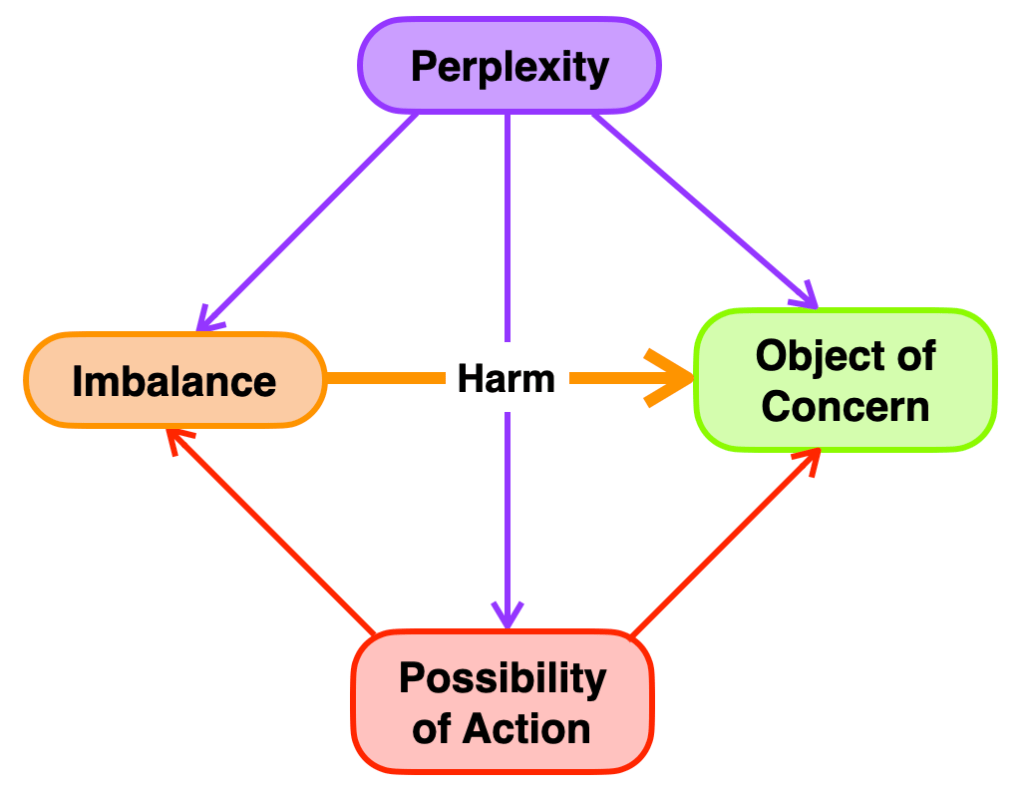
Each element has a particular role to play in understanding and solving a problem. Think of the Object of Concern as the heart of the problem; in addition to adding clarity, it provides the reason and purpose for the problem-solving effort. The Imbalance is the driver of the problem (itself being driven by underlying systems); it is what is threatening or causing harm to the Object of Concern. While Possibility of Action represents that initial hope or desire to do something, the Possibility of Action, in Collaboratic’s framework, is a temporary placeholder for a clearly defined Action that will solve the problem. Understanding the Imbalance and the nature of its harm is the role of Perplexity. However, the chief role of Perplexity is to understand where and how to intervene in order to transform the Possibility of Action into a specific Action. And implementing that specific Action is what solves the problem. Resolving the problem means that the Imbalance and its harm are somehow dissolved or neutralized to render the Object of Concern whole (i.e., back to normal, safe, healthy, …). That is the essence of problem-solving, and it is a process with a beginning and an end.
Collaboratic’s Problem Framework is not simply a static linking of elements. In Collaboratic’s Problem-Solving process, problem elements emerge, transform and disappear as progress toward a solution is made. The Problem itself it is transformed into a Task when the Action is defined. Collaboratic’s Problem-Solving Process follows three broad stages: Formulate, Figure Out, and Fix. This simple progression provides a general roadmap and a way to maintain perspective when deliberations dive deep into details. Collaboratic’s deliberative process follows this same progression. The accompanying animation hopefully conveys this dynamic problem-solving process.
Collaboratic’s Problem-Solving Process begins with an assumed collective muddle. People who gather at the table have a wealth of experience, individual points-of-view and opinions, but are not on the same page. The Formulation stage distills from those views the essence of the Object of Concern, the Imbalance, and the Harm. The Formulation stage is finalized by adding the Possibility of Action and Perplexity, thus completing the framework. By adding the Possibility of Action, the group is affirming their sense that something can be done (“We think we can do something about this.”) and can proceed to the next steps. Perplexity follows the Possibility of Action because the group now has something to figure out. The Figure Out stage involves the activities of understanding and deciding. In this stage, understanding the Imbalance (and its underlying systemic drivers) helps pinpoint were to intervene and devise an appropriate remedy. Choosing that remedy, the Action, then transforms the Problem into a Task. At this point, Perplexity is eliminated and disappears from the framework and the group now has an Action awaiting implementation (the definition of a task). The Fixing stage is where the Action is implemented. The Fixing stage ends when the Imbalance is dissolved. Once dissolved, the problem is solved and the group’s work is done. This is far easier said than done; but the aim of this problem-solving progression is to provide a roadmap for what can be a confusing effort.
Talk Different (Deliberative Agenda)
Talking differently involves following the methodical process established in Collaboratic’s Problem-Solving process.
Collaboratic’s Problem-Solving process sets the stage for its Deliberative Agenda. Collaboratic’s two-stage Deliberative Agenda follows the Problem-Solving process in that it starts with a muddle and ends with a task. The Agenda does not follow through to a solved problem, however. I assume that taking action to solve a problem occurs in the field (e.g., the community) and not at the table. Collaboratic’s Framework and Agenda guides work at the table while the group’s selected Action (or Action Plan) guides implementation in the field.
To illustrate the two levels that are the basis for the two-stage agenda, Collaboratic’s Problem Framework is adjusted slightly to show two distinct levels. I call these two levels the Foundation and the Solution Superstructure. The Foundation is the “what’s wrong” part of the problem and the Solution Superstructure is the “what to do” part. The Solution Superstructure is built upon the Foundation, just like a house is built upon its foundation. Together, they define the two stages of Collaboratic’s Deliberative Agenda.
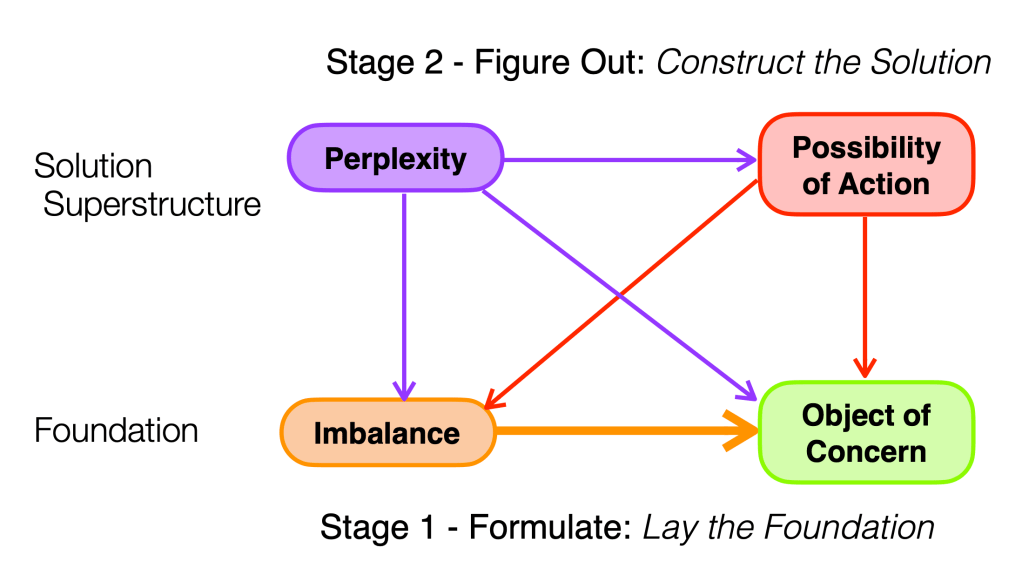
Think of the Deliberative Agenda as following a process similar to that of building a house. When constructing a house, the foundation is laid first then the frame is constructed upon that foundation and the house’s superstructure is completed as the roof, walls, floors and other components are added. In Collaboratic’s deliberative process, the group lays out the problem’s Foundation first (the “what’s wrong” part of the problem), then the Solution Superstructure is constructed on that foundation.
Laying the Foundation in Stage 1 is where the group works out the Problem Foundation. They focus on defining their Object of Concern (What is really important?), identifying and describing the Imbalance (What is really out of whack?) and the nature of the Harm (How is the Object of Concern being harmed?). Starting with a collective muddle, the various views and opinions of the group are identified, explored, winnowed and distilled. Once the Foundation the Imbalance, Harm and Object of Concern are defined, the group then introduce the elements Possibility of Action and Perplexity. Doing so essentially affirms that there is some possibility of taking action to solve the problem. This completes the Formulation Stage. With the initial Problem Framework now set, the group can then proceed to Stage 2 of the Deliberative Agenda, Constructing the Solution.
The bulk of the group’s work occurs in Stage 2. And Stage 2 is complete when the group is comfortable and confident enough with their proposed Action to move forward with its implementation. In Stage 2, the group works to understand the Imbalance and Harm and figure out their solution. During Stage 2, the groups moves into Perplexity mode where they have two main tasks. The first task is to understand the Imbalance and harm, its causes, the systems that are driving it, and how those systems work. Research, analysis, diagnostics or experimentation may be necessary to understand the imbalance and pinpoint where to act. History often comes into play by providing perspective, context, and possibly clues as to how things became this way and what systems might be involved. Once the Imbalance is understood, the group’s emphasis shifts to figuring out how and where to act. It is at this point that Possibility of Action begins its transformation into a specific Action.
The second main task in Perplexity mode is to craft and vet an appropriate action. It is here that the group can carefully examine the options that they have identified to ensure their suitability. Is the proposed action feasible? How is it to be implemented? Is a strategy necessary? What resources are required? What are the trade offs in selecting one action over another? What obstacles are anticipated and how are they overcome? What opposition is anticipated and how is it dealt with? All of these questions, and more, may have to be addressed in order to arrive at an action that will solve the problem. When the Action is finally selected (“This is what we are going to do”), the Problem disappears because it has been transformed into a Task. And at that point, Collaboratic’s deliberative process at the table is complete. The group can then proceed to implement their chosen Action.
That’s it. That’s Collaboratic’s simple Framework and Agenda. Collaboratic does not solve problems, it only guides a group to the point of implementation. Hopefully, it makes getting to that point easier and faster. That is what is meant by streamline collaborative problem-solving.
* * * * *
Collaboratic’s simple Problem Framework is an idealized problem model. Its simplicity serves as a guide for understanding a problem and the overall deliberative process. But few public issues are simple. Collaboratic’s simple and idealized problem model prepares the way for approaching more complex problems which I will discuss below.
PART 2 — Collaboratic Applied to Complex Problems
Collaboratic’s simple Problem Framework provides the conceptual groundwork to approach more complex problems. Both the Problem Foundation and Solution Superstructure can be expanded to accommodate greater complexity. Doing so introduces additional (and hopefully useful) ways of thinking different that may lead to new insights. And the graphic nature of Collaboratic’s simple model offers a way to visualize a complex problem.
By complex, I mean that the problem has many parts. I distinguish this from complicated in which a problem not only has many parts, but also adds the dimensions of uncertainty, unknowns, possibly an evolving Foundation, and possible reactionary opposition to proposed actions. Establishing a basis for understanding and communicating complex problems may help a group grapple with complicated problems.
Collaboratic’s simple Framework features one Imbalance, one Object of Concern, one Possibility of Action and one Perplexity—so far, so good. But most public problems have more than one thing out of whack and may have more than one thing of importance. When it comes to resolving the issue, there may be many things to figure out and it may take more than one action to solve. Collaboratic’s framework is easily expanded to help groups grapple with this complexity.
When applied to complex problems, Collaboratic’s four problem elements and their relations remain the same. However, there may be more instances of each element. The group may identify more than one Imbalance and possibly more than one Object of Concern. A complex Problem Foundation, once worked out, might show a network of Imbalances and Concerns linked by impacts and harms. A corresponding Solution Superstructure might show a network of defined Actions, with some Actions supporting other Actions, along with Perplexity elements still awaiting resolution. Below, I will discuss additional “thinking-different” aspects about complex problems, focusing on the Problem Foundation and the Solution Superstructure. Keep in mind that the specific elements of the Problem Foundation and the Solution Superstructure are products of Collaboratic’s Deliberative Agenda crafted by the participants. Each are the result of in-depth discussions and each problem element is packed with information gleaned from those discussions.
The Foundation of a Complex Problem
A complex Problem Foundation may consist of multiple and interrelated Imbalances and Objects of Concern, as shown in Figure 3 below. Creating the complex Foundation is the product of the first item on Collaboratic’s Deliberative Agenda. The elements are linked in a causal network that reads from left to right. In this example, I made-up the linkages for the purpose of illustration. However, in a real-world problem, the linkages are formed by a methodical inquiry of how each Imbalance impacts another. A qualitative description of the impact would then follow and be added to the description of the Imbalance. A similar approach is taken with Concerns. Objects of Concern are different than Imbalances in that they may have linkages of support to each other rather than exacerbating impacts (e.g., your Job supports your Family, both being Objects of Concern). Some Concerns may be linked in a network of support. The Foundation-building question would inquire about if and how one Concern might support another. This qualitative description would also be added to the Problem Foundation overall description. The result is that each individual element may be packed with information arising from in-depth discussions. Cumulatively, the descriptions of the Imbalances and Concerns and their connections form an outline of a story which, I think, is essential for group understanding and for communicating to a wider audience.
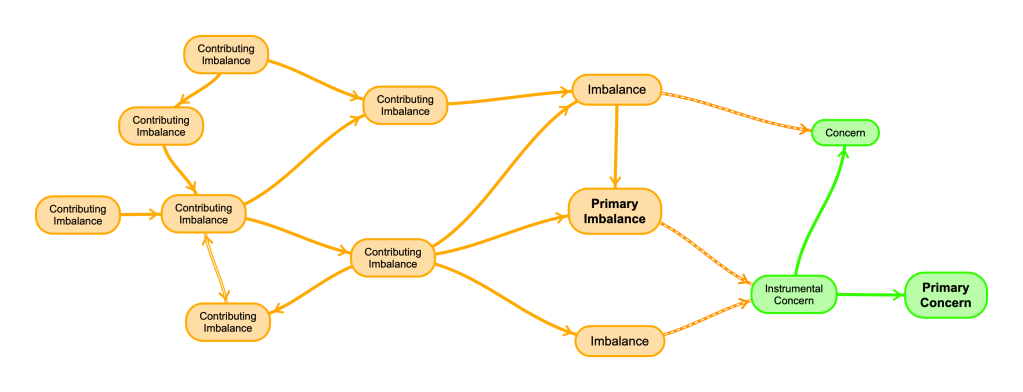
Read the Problem Foundation diagram as you would a highway map by following the arrows from one element to another. The flow of influence, from left to right, is partly set in Collaboratic’s basic problem framework where the Imbalance harms the Object of Concern. In this expanded network, Imbalances may exacerbate other Imbalances before causing harm to the Object of Concern. The flow of influence, then, propagates through the network, generally from left to right (upstream to downstream), to eventually harm an Object of Concern. If the Concerns are linked in their own network, then a Harm is transmitted from one Concern to another, possibly in the form of a disruption of support. Like a road map, the Problem Foundation diagram provides perspective, context and orientation during deliberations and subsequent remedial actions.
The Structure of a Solution (Solution Superstructure)
The Solution Superstructure represents the group’s plan for resolving their problem. It is the product of in-depth discussions at the table. The discussions focus on understanding the underlying Imbalances and Concerns, then devising specific Actions to eliminate those Imbalances. Constructing the Superstructure occurs in the Figure-Out stage of the problem-solving process, so Perplexity’s role is dominant. As in the simple model, Perplexity’s two main functions of understanding the Imbalance and determining an appropriate Action, remain the same. But instead of one Imbalance, the group may have many Imbalances and Actions to figure out.
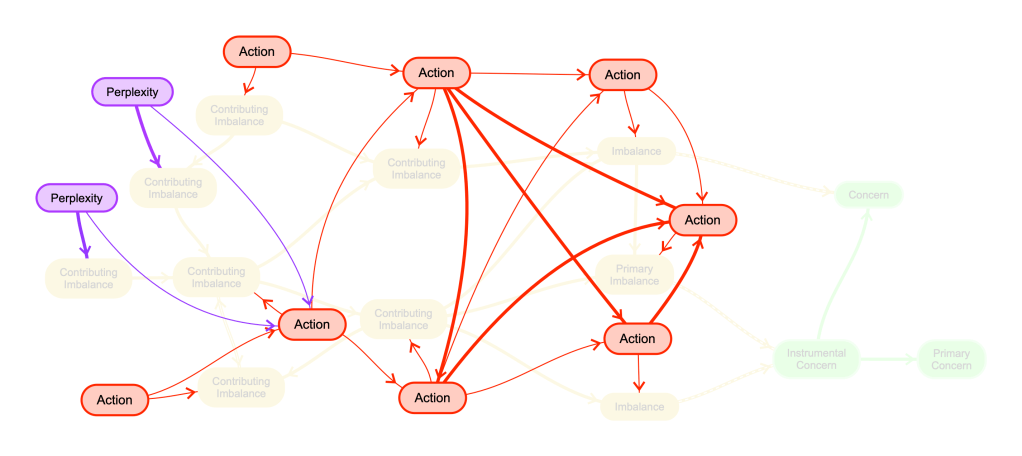
As illustrated in Figure 4, the Solution Superstructure is situated above and connected to the faded Problem Foundation below. It shows multiple red Actions connected to the Foundation by arrows aimed at the Imbalances (“we are taking this Action on that Imbalance”). The Superstructure also shows Actions connected to other Actions indicating the potential of one Action’s support for another. The Foundation’s underlying flow of impacts translates to the Superstructure and can help shape an implementation strategy. The thin arrows connecting Action elements represent “working with the flow.” Neutralizing or fixing an upstream Imbalance may make it easier to implement a downstream Action. The bold arrows represent the possibility of one Action directly providing support for another. So just like a building’s superstructure is connected to itself to provide support and integrity for the whole structure, the Solution Superstructure’s elements may be linked in ways that may provide integrity and effectiveness to the overall approach. Instead of a simple laundry-list of action items, Collaboratic’s approach can offer an implementation logic for the overall solution. Doing so makes it easier for a group to stay focused and communicate to others.
Figure 4 also shows two remaining Perplexity elements in the Superstructure. This represents a mixed Solution Superstructure. As long as unresolved questions are not blocking the implementation of a particular Action, there is no reason to delay: Deliberations about unresolved questions may continue while overall implementation begins.
* * * * *
This brief introduction showed how Collaboratic’s simple Framework can be expanded to create a Problem Foundation that accommodates multiple Imbalances and Objects of Concern and then a Solution Superstructure that contains multiple Actions. The diagram of both the Foundation and Superstructure is a visual short-cut, similar to a road map, that creates both perspective and context for a complex issue and its corresponding multifaceted solution. As products of in-depth deliberations, the descriptions of the elements and their linkages can tell a story that helps keep the group grounded as well as helping the group communicate to others to garner their understanding and support. Collaboratic is a different way of thinking and approaching complex problems.
A caveat of sorts: Problems are perceptual entities. Problems are products of world views and situations. World views determine the perception of an Imbalance and an Object of Concern. My intent is that Collaboratic be applied to the deliberation of public problems as a means of clarifying communication within a democracy. This means that Collaboratic may be inserted into a wider political context as an aid for a particular interests or groups. But Collaboratic is not a consensus tool. It will not bring about consensus if underlying differences in world views are at odds (e.g., climate change is real vs. climate change is a hoax, or white supremacy vs. multiracialism). It may make those differences and the choices clearer. Where opinions and points of view differ, Collaboratic may allow the ability to compare and contrast problems generated by differing points of view and form the basis for a conversation about how to deal with those differences.
 Collaboratic